



Sometimes a single glance, a touch of light on a sweater, is enough, and you know: That is Mohair.
This fine, shimmering yarn with its characteristic fluff - the so-called Halo - gives every knitted piece something almost magical.
Light, soft, luxurious, and yet durable - Mohair is one of the most noble natural fibers in the world.
In this article, you will learn what makes Mohair so special, how to best use it, and why it is worth processing this fiber with respect and love.
What is Mohair?
Mohair comes from the Angora goat, an old, noble breed whose coat is particularly long, silky, and shiny.
Unlike sheep's wool, mohair has a Smooth, almost glass-like surface, which reflects light and provides this distinctive shimmer.
Origin & history
The Angora goat originally comes from the region around Ankara (formerly: Angora) in Turkey.
Today it is mainly produced in South Africa, but also kept in parts of Europe and America.
Mohair has been considered a luxury fiber for centuries - valued for its Softness, lightness, and warmth.
Already in the 18th century, mohair was coveted in Europe, and to this day it symbolizes Craftsmanship elegance and natural sophistication.
Mohair properties at a glance
|
Feature |
Description |
|---|---|
|
Fiber origin |
Hair of the Angora goat |
|
Texture |
Smooth, shiny, with fine down (Halo) |
|
Feeling |
Soft, featherlight, airy |
|
Heat output |
Very high, insulating, without weighing down |
|
Elasticity |
Slightly stretchy, shape-retaining |
|
Shine |
Silky to pearly |
|
Care |
Wash gently, air dry |
💡 Special feature: Mohair warms without weighing down - a scarf made of Knitting for Olive Soft Silk Mohair feels like a breath on the skin but reliably keeps warm.
The famous mohair halo
The Halo is the trademark of mohair.
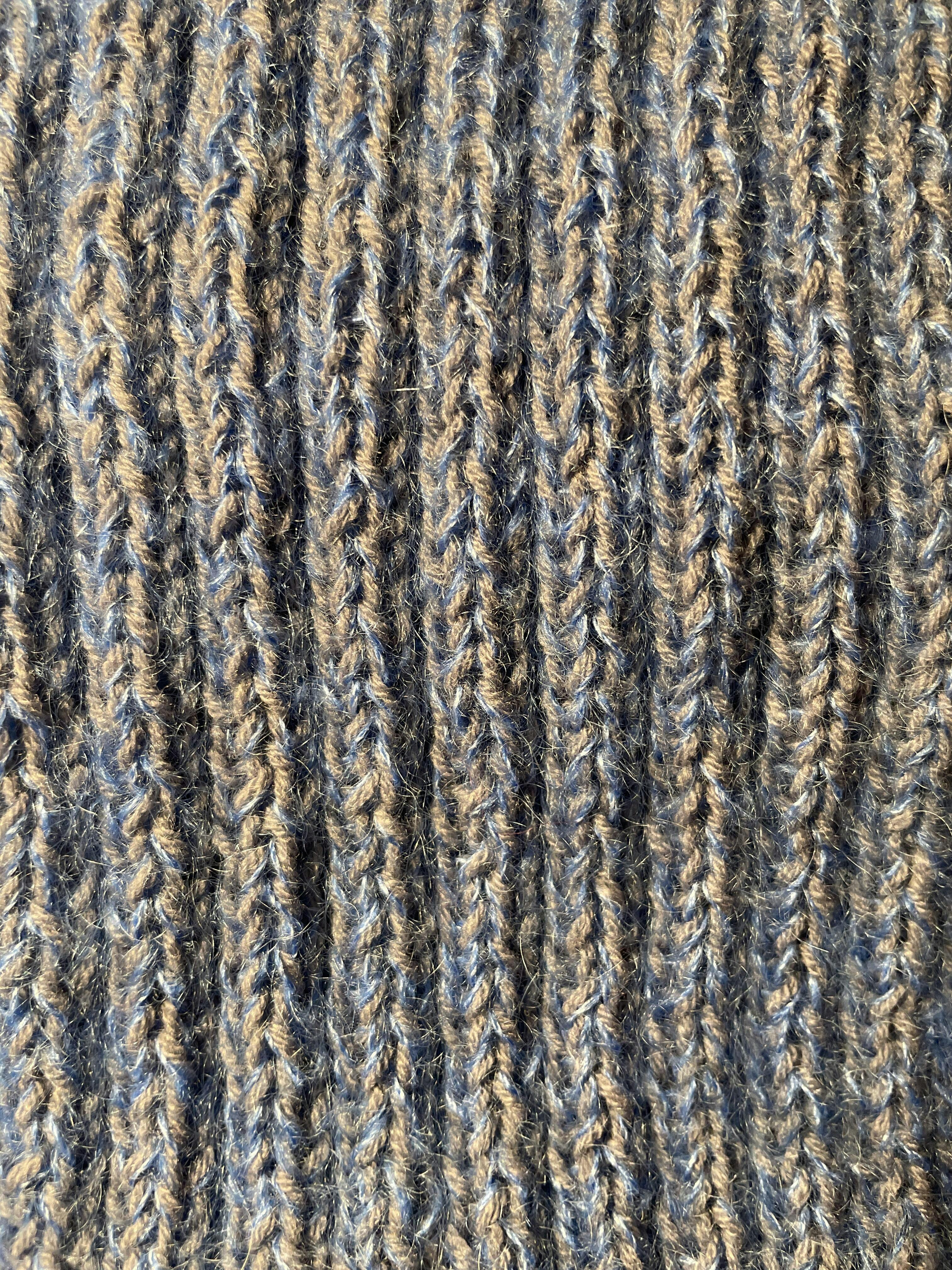
It refers to the fluffy, translucent shimmer, which forms when the fine fibers slightly protrude from the yarn.
Why does the halo form?
The smooth, long hairs of the Angora goat do not take the same twist when spun as virgin wool.
This causes them to loosely wrap around the yarn core - the result is this soft, misty halo.
Effect in the knit pattern
-
The knit appears slightly blurred, almost painted.
-
Stitches "blur" - small irregularities are invisible.
-
The fabric gets Volume and depth, but remains transparent and airy.
👉 Tip: If you want to highlight textured patterns (e.g. cables or lace), use less halo - e.g. through a mohair blend or in combination with smooth yarns.
Mohair and its blends
Pure mohair is rarely knitted alone, as its smooth surface has little "grip."
It is mostly combined with other fibers - for stability, grip, or special shine.
Popular blends
-
Mohair + Silk:
luxurious, shiny, delicate - e.g. Knitting for Olive Soft Silk Mohair
→ Perfect for fine shawls, sweaters, or as an accent thread. -
Mohair + Wool (e.g. Merino):
warm, voluminous, with a soft fluff.
→ Ideal for jackets, winter accessories, cozy sweaters. -
Mohair + Nylon:
for stability in yarns with very fine thread, e.g. Laceweight.
💡 Combination tip: Hold Mohair double or with a second yarn - for example with Merino or Alpaca - for new textures. This creates a full, feather-light knit with a lively surface.
Mohair in use: How to work with it
1. The right needle choice
Choose smooth but not too slippery needles - e.g. wood or bamboo.
Metal needles can be too fast with smooth mohair threads.
💡 Rule of thumb: Preferably a slightly larger needle size, so the fabric can breathe and the halo can fully develop. For lace yarns made of mohair often 4,0-5,5 mm.
2. While knitting
Mohair has a "will of its own": once knitted, it likes to hold on tight.
Undoing mistakes is a matter of patience.
Tips:
-
Knit conscious and calm - Mohair rewards mindfulness.
-
Avoid knitting too tightly so the fluff has room.
-
When you unravel: Slowly and with feeling, stitch by stitch.
3. After knitting: Washing & Care
Mohair is sensitive - but not complicated if you know how.
This is how you care for mohair properly:
-
Hand wash in lukewarm water with wool detergent.
-
Do not rub or wring, but move gently.
-
Press out with a towel, never wring.
-
Dry flat on a towel, away from direct sunlight.
After washing, the halo often stands out even more beautifully - your knitted piece gets this soft, floating character.
Mohair in fashion & crafts
Mohair is a chameleon among yarns:
It can noble and delicate, voluminous and modern or rustic and charming work - depending on how you combine it.
Inspirations for Mohair Projects
-
A fine lace scarf:
Light as air, perfect for layering. -
A sweater with mohair plied yarn:
Simply knitted, but with a luxurious shimmer. -
A loose cardigan:
Quickly knitted, soft, with lively texture. -
Accessories with a "halo effect":
Hats, wrist warmers, scarves - sensual and feather-light.
👉 Experiment with combinations:
A mohair thread with Knitting for Olive Merino creates a soft, velvety knit with depth and warmth.
Sustainability & animal welfare
At Bonifaktur, we value ethically sourced fibers.
High-quality mohair comes from farms that treat animals with respect, shear regularly, and do not use harmful practices.
💚 How to recognize good mohair:
-
Certificates such as Responsible Mohair Standard (RMS)
-
Soft, even fiber without hard spots
-
No chemical smell, natural elasticity
Sustainable mohair is durable, recyclable, and brings joy for many years - a true Slow Crafting-Material.
Frequently Asked Questions (FAQ)
Is mohair scratchy?
Not if it is of high quality. Fine kid mohair (the first shearing of young goats) is especially soft and suitable even for sensitive skin.
Why is mohair so warm?
The fiber has a hollow structure - it traps air and insulates excellently without being heavy.
Can I combine mohair with other yarns?
Yes! Mohair is often used as a companion thread to add structure, depth, and softness.
How do I prevent fuzz?
A light Halo belongs to mohair. Through gentle washing and wearing, the fluff settles - and the yarn becomes even more beautiful over time.
Conclusion: The poetry of mohair
Mohair is more than just a yarn.
It is a feeling - light, floating, warming, alive.
It gives knitted pieces soul and character, transforms simple designs into something special, and connects technique with emotion.
Once you have knitted with a thread of Knitting for Olive Soft Silk Mohair, you will recognize the moment:
That quiet glide, the gentle shimmer, the warmth that barely weighs.
🧶 Embrace mohair - not as a trend, but as an encounter with a fiber full of history, light, and ease.
Knitting Techniques Masterclass: From Beginner to Virtuoso
RMS explained: Responsible Mohair Standard